

Difficulties remembering? Just close your eyes and it will all come flooding back. This is not actually a particularly new finding, with several studies showing that eye closure can improve witness recall in the context of forensic psychology.

Guest Article by Neil McLennan.
A recent article I was privy to, having been circulated around the RSE Education Committee, provides an interesting headline and an interesting challenge for researchers. So far, Research the Headlines has been about putting journalists on the right track when reporting on research released (as well as offering guidance to consumers of news). Furthermore, it has been about sending out research to journalists that has gone ‘under the radar’ (like this post here) and deserves further public exposure. However, on this occasion I would like to flag something up that has appeared in the press to researchers. Read more…

We’re now 9 days into 2015 and people are already starting to break their New Year’s resolutions. However, according to a recent article in the Daily Mail, the only resolution you need to stick to is getting more sleep and the rest should be easy to keep. But is it really that simple?
If someone suggested you could boost your brainpower with a small burst of electrical stimulation from electrodes attached to your head, would you give it a try? Apparently, some people have been doing exactly that, either buying ready-made kits designed for the purpose or using instructions online to build their own DIY versions.
New research has shown that while such transcranial electrical stimulation may indeed provide a benefit to some, it appears to depend on specific characteristics of the individual. The question raised by the study is then: “cognitive enhancement or cognitive cost”?
Another year has gone by at Research the Headlines, and we’re going from strength to strength. The Young Academy of Scotland took on a new cohort of members, and we’re delighted to have new contributors writing about topics like Islamic State, Ebola, Muslim integration in Britain, sex and language, milk, and whether C-sections increase the risk of autism (answer: no). Read more…

Here we go again…
Here’s one for all you festive Scrooges out there. The National Grid is teetering on the brink of collapse, and your fairy lights could tip it over the edge:
“A TEAM of experts whose jobs are based on creating winter wonderlands are appealing for [..] residents to switch to low-energy fairy lights this Christmas. The Christmas Decorators… [are] urging the public to use energy efficiently this Christmas to ease pressure on the National Grid.” (Southern Daily Echo, 24th Nov, and others since).
The headlines are right to the extent we are experiencing some big structural changes to electricity generation in the UK, with many of the ‘super stations’ of the 1960s and 1970s being closed under the European Union’s Large Combustion Plant Directive. But are your fairy lights really the difference between a festive winter wonderland and the apocalypse? Probably not. Read more…

According to the famous saying, there are three types of lies: lies, damned lies and statistics. Earlier this month, we had some of the latter, though interestingly the statistics concerned the extent to which researchers exaggerate their findings in press releases, and how that exaggeration filters through to media reports. The Independent’s headline suggested “Bad science reporting blamed on exaggerations in university press releases”, so just what have us researchers been up to?

As we all lapse into boozy Christmas comas on the couch in front of the TV, some of us might be woozily remembering headlines that proudly stated “Humans have been drinking alcohol for ten million years“.
Is it true that humans have really been on the sauce for ten thousand millenia? And how can we know? It might seem like that bottle of Cinzano at the back of the drinks cupboard is pretty old, but not that ancient.
These headlines are based on research published in the Proceedings of the National Academy of Sciences. Before we go deconstructing these stories, let’s get our facts right on a few things first. Read more…

Last week, it was announced that the 23andMe genetic test is “now available to UK customers”. The news was reported with the headlines focusing on the idea that the UK might be too relaxed and less careful than the US on controlling direct-to-consumer genomic companies: DNA-screening test 23andMe launches in UK after US ban, Controversial DNA test comes to UK, Google-Backed Home DNA Screening Banned In America Comes To The UK. Read more…
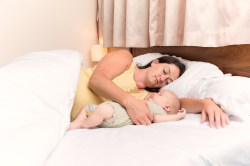
The National Institute for Health and Care Excellence (NICE) provide guidelines on a vast range of aspects of health care issues. This week NICE updated their 2006 guidelines on postnatal care (Guideline CG37) which included recommendations on co-sleeping (defined by NICE as parents or carers sleeping on a bed or sofa or chair with an infant) and sudden infant death syndrome (SIDS) up until infants are one year old. The updated guidelines report “an association between co-sleeping and SIDS” but also states that “the evidence does not allow us to say that co‑sleeping causes SIDS”. So what does this mean and how did the media handle this potentially complex message? Read more…


 researchtheheadlines.org