

Reducing carbon emissions to minimise climate change is a global challenge, which 195 of world’s countries have agreed to work towards. Unlike most human modifications of the planet, the effect of carbon emissions is truly global, and can only be avoided through global cooperation. Based on overwhelming scientific evidence and substantial negotiations, the Paris agreement set the target of keeping global average temperature increase below 2°C, while attempting to limit it to 1.5°C above pre-industrial levels. The agreement opens scientific questions as to whether this target is achievable, and, if so, how it could be achieved. This study set out to answer these questions using carbon cycle models and emissions scenarios. The results caused a media storm of divergent reports.
 Dr Theodore Koutmeridis is a Lecturer in Economics at the Adam Smith Business School at the University of Glasgow. He holds a PhD in Economics from Warwick University where he was a Royal Economic Society Junior Fellow and an Onassis Scholar, and he has recently been a Visiting Scholar at Columbia University. His work on economic inequality and crime has been recognised with various awards, such as the Sir Alec Cairncross Prize, the 1st Prize of the ‘European Science Days’ Interdisciplinary Award, the British Academy Rising Star Award, grants by the ESRC, and has been featured in the media and various symposia, such as his TEDx talk on ‘The Underground Economy’. His contribution to the YAS Brexit Report highlighted the opportunities and risks of Brexit to the Scottish Economy, and also the role of the media in communicating socioeconomic issues.

Every so often, an article comes along that purports to be based in quantitative research, where we in RtH don’t particularly care whether the research is represented well or not. A good example is the recent Daily Mail piece on “the perfect woman“, which collates quantitative measures of various aspects of the female body in an attempt to find what features are “the most attractive”.

For parents of newborns grappling with limited sleep, a headline such as ‘babies who sleep in separate rooms from their parents…..get more shut eye’ is bound to raise an eyebrow. The latest findings, at first glance, seem to challenge official guidelines that babies should sleep in the same room as their parents until at least 6 months. Indeed the reporting specifically claims the findings challenge the guidelines. On closer inspection though, the headline and the article is riddled with misinterpretations of the study findings. So what does the study actually reveal?

Dear readers, as it’s August again we would like to welcome you to another roundup of research related shows on at the various festivals hosted in Edinburgh this month. These include the Edinburgh Festival Fringe, its more prestigious elder, the Edinburgh International Festival, the Edinburgh International Book Festival, and the Edinburgh International TV Festival. As we have done in previous years (2014, 2015) we would like to provide suggestions for research-related shows and events for any Research the Headlines readers who may be visiting Edinburgh this month.

The process of peer-review is one of the pillars of modern scientific research. In its ideal form, researchers submit articles to a journal, which selects expert reviewers to read the manuscript, assess its quality, and either reject the article or ask for corrections before it is published. This process (along with careful editorial control) ensures that when research is published, its content is accurate, honest and of value to the scientific community.
Even in our modern age of preprint servers, where new research can be downloaded for free, peer-review remains the gold standard, and journals remain the gatekeepers of the peer-review process. Sadly, not all journals hold their article to the same high standard.
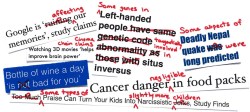
When we talk about research in the media, it’s often assumed we’re focussing primarily on the way journalists or the media might misrepresent solidly conducted and robust research. While that does happen, and we’ve talked about that in various posts at Research the Headlines, it’s important to remember the translation of new research from “lab to headline” is a process that involves a number of people. Inaccuracies can creep in at different stages and those can ultimately affect the way people interpret that evidence, or indeed trust the whole process. That’s just one of the topics considered in a new report from the Academy of Medical Sciences released last month.The report, “Enhancing the Use of Scientific Evidence to Judge the Potential Benefits and Harms of Medicines”, provides some really interesting figures that might be a bit of surprise to many people (it mainly focuses on information about the use of medicines, but is equally applicable to almost any area of research that could impact on the decisions people make in their day to day lives). One of the findings reported was that:
“only about one-third (37%) of the public said they trusted evidence derived from medical research, but around two-thirds (65%) trusted the experiences of friends and family.”
That suggests quite a gap between what we hope are well-conducted studies given the best possible evidence and how people actually choose to access health-relevant information.
Read more…
The most abundant biological entity on the planet is the bacteriophage (literally bacteria-eater) – and yet there have been long debates over whether they are really ‘alive’ – see here. Bacteriophages are viruses that infect and kill bacteria and are sometimes simply called ‘phage’. They attach to their bacterial host, inject their DNA and ‘take over’ the host, making the bacterial cell in to a bacteriophage factory. Once the progeny bacteriophage are assembled, they burst out of the bacterium, killing it and releasing the phage to go on and infect more bacteria.

Compared to the belching fumes and loud noises we are bombarded with when walking beside a busy street, the environment within a car seems quite peaceful. This sense of security leads many people to believe that being in the car protects them from air pollution and particulates. Parents might think this is especially the case for small children, with their lower stature and delicate developing bodies. But is it better for your kids’ health if they walk or cycle, even if exposed to urban air pollution, or take the car.

There has been considerable media interest in a study that examined the impact of an African sleeping sickness drug, suramin, on children with autism spectrum disorder (ASD). Some media reports take a very hopeful view of the drug and its ability to treat children with autism with headlines evident such as ‘New autism drug shows promising results’ and ‘Century-old drug, suramin may provide hope for autistic kids’. Headlines such as these merit a closer look at the research behind them and what this means for those with autism.


