
The term ‘brain training’ has entered common usage in recent years, and though it can refer to a range of things, it predominantly describes computer-based exercises or games which are specifically promoted as protective for the ageing brain. If you perform a quick search for “brain training” on the internet you’ll quickly have a wealth of news articles and webpages referring to the idea. Studies of brain training are frequently reported in the media, given the interest in any product that might help people delay or even reverse the declines in memory and thinking skills associated with age. A recent study was reported in the Guardian under the headline: “Brain-training video games may help reverse cognitive decline in old age”.
Recent coverage of a study that has examined communication problems in children with high functioning autism spectrum disorder (ASD) has led to the conclusion that children with the disorder can outgrow their communication problems. When we actually look at the study itself, however, it is not designed to make such definitive conclusions.
Who conducted the study and what did they do?
Eight authors from different institutions published the study in the Journal Cerebral Cortex, on August 28, 2013. The first and corresponding author John J. Foxe, is based at the Department of Pediatrics, Albert Einstein College of Medicine, New York.
John J. Foxe, Sophie Molholm, Victor A. Del Bene, Hans-Peter Frey, Natalie N. Russo, Daniella Blanco, Dave Saint-Amour, & Lars A. Ross (in press). ‘Severe Multisensory Speech Integration Deficits in High-Functioning School-Aged Children with Autism Spectrum Disorder (ASD) and Their Resolution During Early Adolescence’. Cerebral Cortex. doi: 10.1093/cercor/bht213
They are in the air, in our homes, in our food. We are reminded by the press every day that chemicals are invading our lives. But what does this really mean? As technology advances irrepressibly, are our lives becoming ever more toxic? This guide will hopefully allow you to make an informed response to the latest news story.
What did the Researchers say?
The researchers were interested in testing an aspect of Life History Theory. Life History Theory suggests that the key events in an organism’s life – the development of the young organism, the advent of its reproductive ability, its attitude towards parenting, and even its death – are tuned by natural selection in such a way that its offspring receive the best possible benefit. This means, for example, there is often a trade-off between the effort invested in mating and the subsequent effort invested in rearing young. At the extremes, organisms could put all their effort into mating and walk away from their offspring, or only mate once and become a perfect parent. Or, as is more common, the organism’s behaviour lies somewhere in between these two extremes.
Jennifer S. Mascaro, Patrick D. Hacket & James K. Rilling (in press). Testicular volume is inversely correlated with nurturing-related brain activity in human fathers. Proceedings of the National Academy of Science. doi: 10.1073/pnas.1305579110
“The evidence seems to be building that we are actually all Martians; that life started on Mars and came to Earth on a rock”
Prof Steven Benner, Westheimer Institute for Science and Technology
Where do we come from? One of the most hotly debated questions in science and philosophy centres around the origin of life itself. Even defining what life is can be controversial. Scientists often begin tackling this question by investigating the chemical building blocks of life – peptides, DNA and RNA – and how, and where, these materials are assembled. Experiments that attempted to replicate the synthesis of these biomolecules, by recreating conditions thought to be like the young Earth, have failed to produce substantial results.
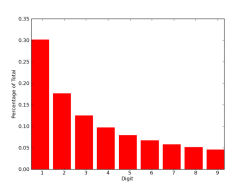
Even in today’s world of powerful technological surveillance, fraud remains part of our lives. Corrupt leaders rise to power thanks to fraudulent voting, rogue employees embezzle their companies, and unscrupulous government officials steal from the state and the taxpayer. How can we catch these criminals without giving up too much of our civil liberties?
In some cases, a quirk of mathematics can come to the rescue. Imagine that I collect a list of the heights of all the mountains in the world. Now, I take these numbers and collect the first digits. How many ones are there? How many twos, threes, fours, etc?
What did the Researchers Say?
This research is not directly focused on creativity, but on the need for closure. This isn’t quite the “closure” that soap opera characters crave when extricating themselves from a messy relationship, but there is a similarity there. The closure the researchers are looking at is “cognitive closure”, about which they say
Cognitive closure is the need to reach a quick conclusion in decision-making and an aversion to ambiguity and confusion.
Djikic, Oatley & Moldoveanu (2013). Opening the Closed Mind – The Effect of Exposure to Literature on the Need for Closure. Creativity Research Journal, 25(2), 149-154. doi: 10.1080/10400419.2013.783735
Broadly speaking, this means that if you crave this closure, you are more likely to make a snap judgement, and less likely to change your judgement as new evidence comes to light (sometimes referred to as “freezing”).
People are rightly interested in lifestyle factors that might determine how their memory is likely to change as they get older, and a recent study published in the journal Neurology examined the association between consuming cocoa and brain function. When reported in the media, some outlets made reasonably bold sounding claims announcing that “Drinking hot chocolate could prevent Alzheimer’s by boosting blood flow to the brain” (the Daily Mail), although some were more measured (the BBC’s headline being “Cocoa ‘might prevent memory decline'”). So, should we up our cocoa consumption to reduce our risk of memory impairment?; let’s look at the study.
The Guardian (25th July 2013) reports:
“Scientists have implanted a false memory in the brains of mice in an experiment that they hope will shed light on the well-documented phenomenon whereby people “remember” events or experiences that have never happened.”
While this may seem like a claim out of science fiction, the article itself is a good example of science reporting. The Guardian’s science correspondent, Alok Jha, provides a clear statement of the findings, and also sought out critical viewpoints from experts in the fields of memory and neuroscience. In actual fact the technique used is somewhat similar to classical conditioning, such as the famous experiment of “Pavlov’s Dog”. In this, an animal learned to associate a stimulus, such as the ringing of a bell, with the delivery of food. In the end they would eventually salivate when the bell was rung even when no food was forthcoming.
Steve Ramirez, Xu Liu, Pei-Ann Lin, Junghyup Suh, Michele Pignatelli, Roger L. Redondo, Tomás J. Ryan, Susumu Tonegawa (2013). Creating a False Memory in the Hippocampus. Science, 341(6144), 387-391. doi: 10.1126/science.1239073
The media have been very interested in a recent research study that examined video game use in children with the developmental disorders Attention Deficit Hyperactivity Disorder (ADHD) and Autistic Spectrum Disorder (Autism). This interest, in part, seems to stem from the idea that video games are harmful – for example, the Daily Mail coverage repeatedly refers to ‘addiction’ when describing the study. There is also an underlying suggestion that excessive use may cause or at least contribute to the development of these disorders. The study, however, was not designed to assess these possibilities. But more importantly, taking another perspective, the coverage ignores the strategic growing use of technology by parents, teachers and caregivers of children with these disorders to maximise learning and social development. So is increased video game use in these children a sign of ‘addiction’ or otherwise negative to their development?
Micah O. Mazurek & Christopher R. Engelhardt (in press). Video Game Use in Boys With Autism Spectrum Disorder, ADHD, or Typical Development. Pediatrics. doi: 10.1542/peds.2012-3956


 researchtheheadlines.org