
Is my brain filling up with plastic?

This post was written by Meghan Perez-Keepax and Sinead Rhodes
A study, published in the journal Nature Medicine, recently made the headlines due to its findings that there has been an increase in plastic detected in brain autopsy samples. In this blog post, we look at reporting by the Guardian, Washington Post, New York Post and the Independent on this study.
So how did these major news outlets fair with their reporting and how concerned should we be about the study’s findings?
First it was good to see that all four outlets reported the number of brains looked at in the main part of the study (52). The New York Post got this in early in the article. The other three waited until the bottom half i.e. the part that a lot of readers never get to.
Why does this matter? Because this is a small study where the individual results vary a lot. This causes a lot of uncertainty.
The Guardian, Washington Post and New York Post all reported an average increase of 50% in plastic between the 2016 and 2024 brains. This number is correct and, without context, sounds pretty dire.
We are very certain that the 2024 cases were drawn from a real-world pool that is on average higher than the 2016 one. However, we cannot confidently say how big the difference is. 50% is the current best estimate but the real-world impact could be drastically different. In short, more data is needed.
The Guardian chose to double down on emphasising the 50% increase by showing it in a long thin graph. The following are the same numbers charted using different dimensions and give quite different impressions at a quick glance.
Long thin graph:

Short wide graph
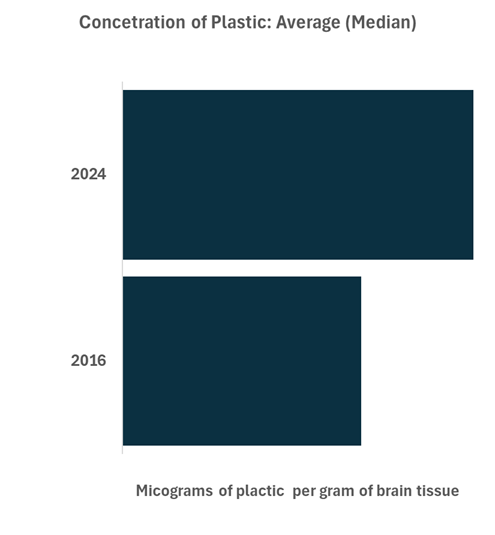
The Independent took the opposite approach, avoiding statistics altogether and describing the trend as “substantially higher”. This again underplays the level of uncertainty.
A separate part of the study looked at brains with dementia and found they had clearly higher concentrations of plastic. Here the Washington Post showed excellent reporting:
“Patients with dementia have weaker blood-brain barriers, they warn, and have a harder time clearing toxins from the brain. In human brains, therefore, the high numbers of microplastics could be an effect of dementia or Alzheimer’s, rather than the cause.”
The Independent and the Guardian both reported that the dementia results do not show a “causal link” which is true, but not particularly clear. The New York Post’s wording that “researchers cautioned that further study is needed to establish a direct link” could incorrectly imply that the researchers expected to discover that plastic caused dementia.
So, should we be worried? The unsatisfying but truthful answer is that, at the moment, we just don’t know. Sometimes scientists need the time and resources to get a clearer picture. The Guardian finishes with a good summary of the situation:
“Prof Oliver Jones, at RMIT University in Australia, said the new research was interesting, but the low number of samples and the difficulty of analysing tiny plastic particles without contamination meant care should be taken when interpreting the results.”
It is clear more research is needed on this important topic.


 researchtheheadlines.org